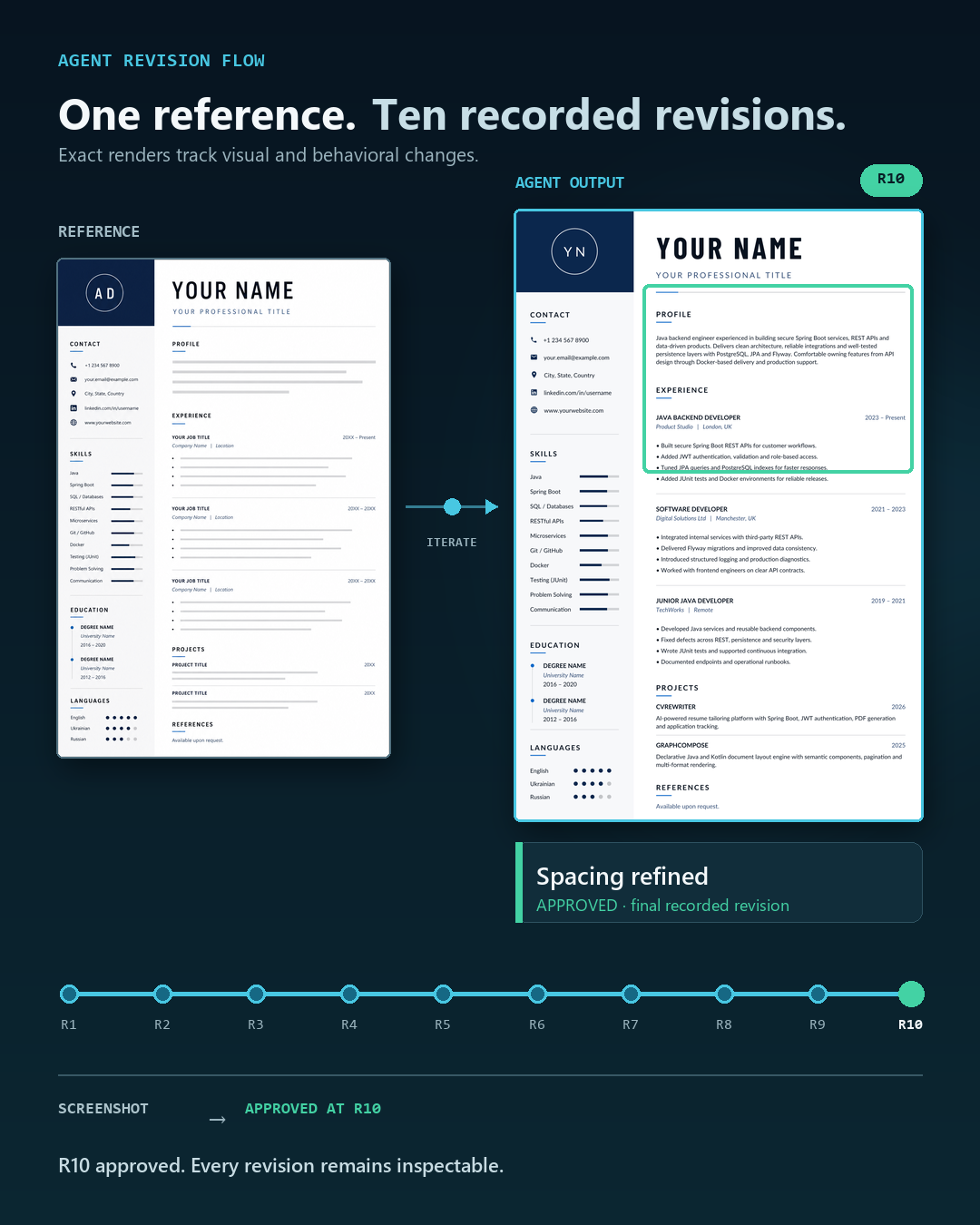
A reference document on the left, an agent's rendered output on the right, and a timeline of ten recorded revisions ending in an approved one

Why Harness Is Becoming One of the Key Parts of AI Development

When all of this started becoming mainstream, there was a lot of talk around artificial intelligence like: “It can already do everything,” “It will replace everyone soon,” “Just give it a task and it will do it.” I spent quite a lot of time using AI, experimenting with it, and trying to understand not only what it can do, but how it actually behaves in real tasks. Even before MCP, when structured output, JSON input/output, API integrations, and attempts to make models behave in a more predictable way were only starting to become common, I kept coming back to one thought: there needs to be a software layer between the human and the AI. ...


25 August 2026 · 10 min · Artem Demchyshyn
Abstract illustration of memory and compute infrastructure for AI data centres

RAM — or What Is Actually in Highest Demand Today?

At the beginning of the modern AI era, researchers discovered a relatively simple pattern: as you increase compute, training data, and model size, neural networks tend to become significantly more capable. One of the most important milestones came in 2017, when Google introduced the Transformer architecture in the paper Attention Is All You Need. Transformers were initially demonstrated on tasks such as machine translation, but it quickly became clear that the architecture could be used for much more. ...

10 August 2026 · 7 min · Artem Demchyshyn
Four abstract monoliths on a dark plain, a metaphor for the four leading AI labs and their different foundations

The Race Where Two Players Have Nowhere to Retreat

Four names sit at the top right now: Google, xAI, OpenAI, and Anthropic. The list of companies shipping something is endless — Meta, DeepSeek, Qwen, and so on. But at the top, where the real competition happens, it’s these four. And they’re playing completely different games. Four players, four foundations Each of the four has its own strength — and that strength isn’t only the model. Google went its own way. They have Search behind them and the whole stack of services half the world already uses. They don’t need to convince you to come to their model — they bake it into the places you already live. Mail, search, docs, your phone. It’s a very strong play: the model doesn’t even have to be the best, because it’s everywhere. ...

15 June 2026 · 6 min · Artem Demchyshyn
A question mark formed from butterfly illustrations on a pale background

Claude Fable 5 and the Shape of Frontier AI Access

On June 9, 2026, Anthropic announced Claude Fable 5, a Mythos-class model made available for broader use with stricter safety layers around it. On June 12, Anthropic added an update saying that access to Claude Fable 5 and Claude Mythos 5 was temporarily unavailable while they worked to restore it. That timeline is already interesting. Frontier AI releases are starting to look less like simple product launches and more like controlled deployment systems: a powerful model, safety routing, monitoring, fallback behavior, access policy, pricing, and operational risk all wrapped together. ...

14 June 2026 · 4 min · Artem Demchyshyn