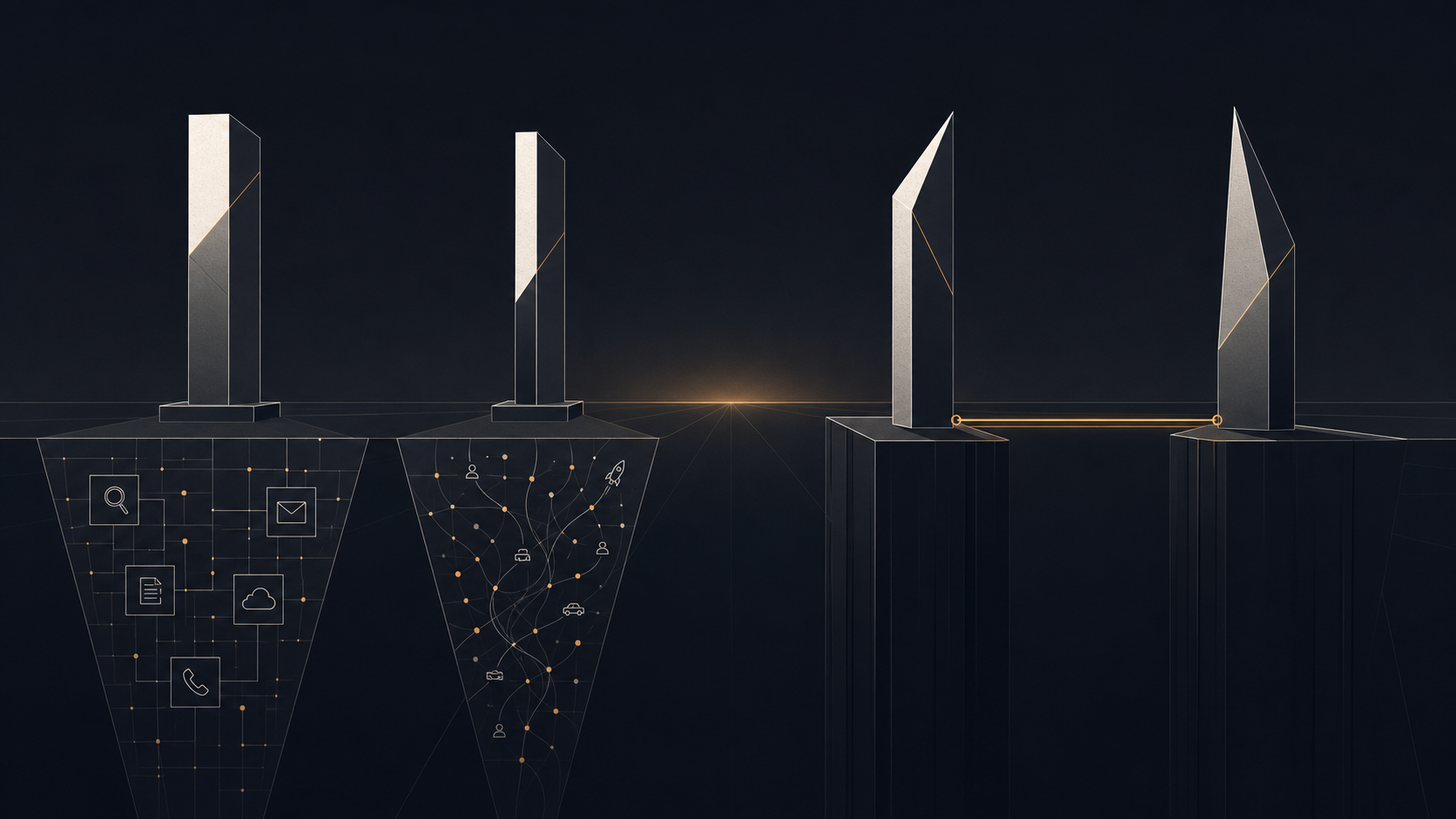
Four names sit at the top right now: Google, xAI, OpenAI, and Anthropic. The list of companies shipping something is endless — Meta, DeepSeek, Qwen, and so on. But at the top, where the real competition happens, it’s these four. And they’re playing completely different games.
Four players, four foundations
Each of the four has its own strength — and that strength isn’t only the model.
Google went its own way. They have Search behind them and the whole stack of services half the world already uses. They don’t need to convince you to come to their model — they bake it into the places you already live. Mail, search, docs, your phone. It’s a very strong play: the model doesn’t even have to be the best, because it’s everywhere.
xAI is Musk. Grok is wired into Twitter, and that’s its strength: a live stream of data, an audience, reach. And behind Musk sits Tesla, SpaceX, a whole empire. He doesn’t want to give up, he’s getting his network in order, and in some ways it’s genuinely decent. Grok won’t disappear, because it’s part of something bigger.
Then come the other two. OpenAI and Anthropic. And here’s the fundamental difference: they have no outside ecosystem to fall back on. They exist purely because they own their models. Everything is on the line. If Google’s or xAI’s model falls behind, they compensate with services, connections, other businesses — the company isn’t going anywhere. These two have nothing to hide behind. Everything they have is the model.
So this is a conversation about those two.
How it started
I’ve been watching this since the first ChatGPT release.
Sam Altman did a public launch, I tried it — and I understood: this is a new chapter, this changes everything. The model was dumb, the answers wrong almost every time. But how it synthesized things was stunning. I was hooked. That’s the moment my close watching of all of this began — how it unfolds, who’s moving where.
At first nobody cared. Nobody understood why this mattered. Everyone thought: toy. Even my girlfriend said — okay, use it if you want. She wasn’t interested. But the start had been made. A year later people were talking about it. Then they started thinking about how to integrate it. And right around then, Anthropic showed up with its own model.
Meanwhile ChatGPT was already being recognized, already being used, and word of mouth did the work. They made a splash and forced everyone to start building their own models — Google, Meta, xAI, DeepSeek, Qwen, an endless list.
Two teachers
I used these models as a teacher. I could always ask until I got it, break things down piece by piece until they made sense, and get explanations back. That gave me a lot.
And I had two teachers — very different ones.
ChatGPT was a talker. Ready to chat and explain a simple answer across two volumes — which wasn’t always what I needed, but plenty of people loved it for exactly that. I was coding, asking for advice. The answers were often wrong, but the syntax wasn’t bad, it gave you a foundation to understand from. The problem was that it was a kilometer-long roll of toilet paper. Sometimes it even ran 😅
Anthropic was different from day one. I noticed it immediately — this wasn’t the talker. Ask how to do something, how to solve a task, and you get a structured answer. Everything cut into classes, separate methods, readable. And not working at all 😅
And here’s the important part. It gave me a sense of how to write properly. Like an engineer — not like an author of giant slabs that work but that you can never touch again afterward. I peeked at how to structure things. The logic was sometimes broken, the information wrong — but the concept itself, the way of thinking, was valuable. I wasn’t learning the answer. I was learning to think.
Meanwhile ChatGPT could hand me a correct answer — but as a slab, and built wrong from an engineering standpoint. But hey, it ran somehow 😅😅
2026: who’s ahead, and why
And now, in 2026, the picture has developed.
On coding, Anthropic holds the top. Their models sit at the top of SWE-bench, and the new flagship sets a new ceiling. Programmers choose Claude. Office workers choose Claude. Professionals don’t need a talker — they need an organized assistant. And Claude was that from the very first day.
But to be fair: this doesn’t mean OpenAI “lost.” Saying that would be untrue. On reasoning tasks, they’re ahead. Gemini wins on price and runs neck-and-neck on a number of benchmarks. What’s happening is specialization, not anyone’s knockout. One leads on code, another on logic, a third on cost. And smart developers in 2026 don’t pick one — they run several in parallel.
And still, on my turf — engineering — Anthropic is ahead, and OpenAI can’t catch up yet. The benchmarks look fine, the model looks good, but it’s still the same talker underneath.
My bet: it’s about the data
We know models get retrained — new layers, new techniques that improve results. But why does Anthropic pull this off more consistently? Here’s where my hypothesis begins.
I think it’s because it was set up differently from the start. And that paid off. And the lion’s share of that “differently” is the data. How you train it, and what you want back. This was collected over years.
And here’s the catch. OpenAI gathered its data for its approach to training. Anthropic for its own. Whatever new model comes out, the data will be the same — just topped up. A huge slab of it is already done. You’ll keep refining the architecture — but the model still learns on the old character. And you can’t dump all your datasets in the trash: that’s years and billions in cost. So you keep using them and wait for a miracle.
Anthropic, meanwhile, will keep improving the architecture — and training on that same quality dataset, sharpened for engineering rigor from the start.
I’ll be honest about where this can be challenged: technically, you can change a model’s behavior without throwing out the corpus — through RLHF, filtering, synthetic data. So “data decides everything” is too strong. But the inertia of a data culture doesn’t go anywhere. What you fed a model for years is what sets its character. And I don’t see what OpenAI needs to do to break that character. I think it could end badly for them.
Yes, these are my guesses. My thoughts. But still.